Allowing for Questions

I had the privilege of giving a short talk before my book signing at the Barnes and Noble in Redlands, California this past Sunday. There was a nice group of about 30 children and parents who listened attentively as I talked a bit about early American history and about my book, The Declaration of Independence from A to Z.

Afterward, one young girl asked me a question no one had ever asked me before, “What was your favorite letter in the book?” I had to think about this a moment. I finally decided on “M is for Majority” because it corresponded with Layne Johnson’s wonderful rendition of John Trumbull’s famous picture of the Declaration of Independence.

It’s important to let kids ask questions. Their interpretations are a bit different from ours, and it helps me understand my audience a lot better.

I’ll be speaking to a group of Kindergarten to Second grade students next month for Career Awareness Week. I can’t wait for all the questions they’ll ask about being a writer. Who knows? Maybe I’ll learn something new about myself by the unique things they’ll ask.
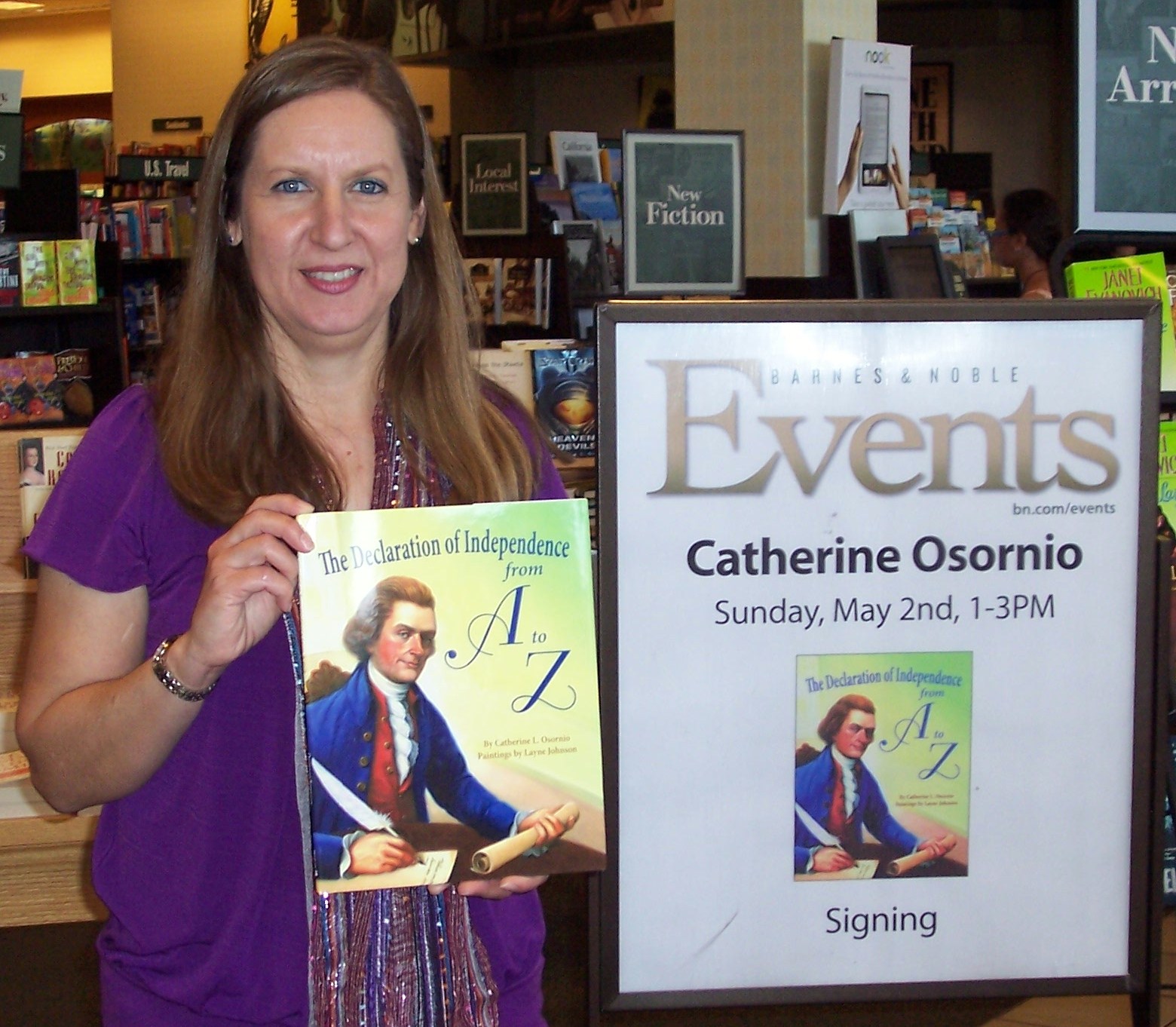
Book signing at the Barnes & Noble in Redlands on May 2, 2010

Keep It Brief

I’m getting ready to send some sample chapters of a mystery story to a publisher who also wants a synopsis of the rest of the book. A lot of writers are intimidated by the word synopsis, but it is actually not too hard to do.

A synopsis is a short summary of each chapter of the book that is usually written in present tense. For mine I read a chapter, then wrote a brief paragraph highlighting the main points of that section. I did this in turn for every chapter, ending up with 20 paragraphs to match my 20 chapters. This made the process manageable and less frightening.

Have a synopsis to write for your book? Keep it brief, and you’ll be done in no time.

Need Inspiration? Take a Walk!

My family and I took a walk around the neighborhood the other day after dinner. We walked a good 2 1/2 miles round trip. There were lots to see and hear. People watering their lawns. Dogs barking from behind tall fences. Fruit trees filled with ripening fruit. Wonderful scents of blossoming flowers.

And even though I wasn’t looking for it, I found writing inspiration in several ways. I saw a ceramic animal and came up with a title for a new novel. We passed by a house that looked dark and sinister; a potential setting for some future story. We saw an old dilapidated cannon nestled in someone’s side yard; a great piece of a puzzle to solve a mystery.

There are wonderful inspirations all around us; ideas waiting to be told in an adventure or mystery or drama. If you ever find yourself lacking inspiration, don’t despair. Take a walk. You may be surprised at what you find just around the corner.

Building a Resource Library

It’s a good thing I like to read because part of my research for any project involves going through lots and lots of reading material. I try to purchase many of these resources to build my own library. For my ongoing research for early America, I have retained over 50 books. I probably have at least that many for some research I had to do for early New Mexico history.

I usually don’t have a huge budget to buy research books, so I have to be creative. Ebay is a wonderful source, but so are thrift stores, yard sales, and library book sales. I have found some wonderful big volume atlases and coffee table-type books for just a few dollars. One time I spent hours digging through a closing out sale at a bookstore warehouse where I discovered some wonderful historical books.

Of course not all of these books are in pristine condition. I can’t afford mint copies, so I have to settle sometimes for some worn issues for the older versions. But as long as I can read them clearly, I don’t mind. I’m looking for access to the information at this time. Perhaps later on I can afford some pricier and cleaner volumes.

Now if only I could figure out where I’m supposed to put all these books…

Building a Good Character

A story needs good characters to carry it along, that’s why it’s important to take time to develop your characters before you begin. Take out a sheet of paper or a few index cards. Decide what type of person he/she will be: antagonist, protagonist, etc. Then work on a name. I often pick up a book of names and glance through it so that my character’s personality is portrayed through the name. You could also do the opposite where you pick a name that is so unlike the person, but through the circumstances in your story he becomes the very description of that name by the end.

Now that I have a name, I start building on physical descriptions, personality types, quirks, and hobbies. Also, what is her back story? Where was she born, how many brothers or sisters (if any) does she have, and does she live with her parents or a guardian? These things are important because it will determine WHO your character really is.

Once you have done this with your characters, and you begin to write your story, let your characters speak for themselves. Show in actions what they do and allow their personalities to come out when they speak. This is how you develop voice. Let your mind be so in tune with each character that they are unique and different from one another in word and deed.

Think back to those great books you’ve read in the past with outstanding characters. They all had their own personalities, their own uniqueness, their own set of words. Now it’s your turn to do the same. Grab that pen and paper and start building your characters!

Schmooze Time

This past Saturday I was the guest speaker for the SCBWI Writers’ Schmooze held at the Barnes and Noble in Redlands, CA. My topic was “Lessons I Learned From Writing a Picture Book.” I had a nice crowd of 10 – 12 people and spoke for about an hour, which included reading my book and answering questions.

Speaking at the Writers' Schmooze at Barnes and Noble in Redlands

Talking about my book, "The Declaration of Independence from A to Z"

It was a fun time with lots of great questions from the attendees. I even used visual aids to help illustrate my talking points, as described in my previous post, “Visual Aids.”

I will be returning to the same Barnes and Noble on May 2nd to read, speak, and then sign books for the Clare Cherry School Bookfair. Come join me if you happen to be in the neighborhood. I’ll be there from 1:00 to 3:00 pm.

Visual Aids

Visual aids are important in any presentation. They help illustrate points and make your talks interesting. Your visual aids can come in the form of graphs, charts, photos, cartoons, and drawings. They can also be props such as time period clothing or sample inventions.

With my upcoming talks and presentations, I’m trying to develop several visual aids I can bring with me. I like to draw, so I’m thinking of making several cartoons to emphasize my talking points. When I go speak to children, I plan to bring props to show the time period of my picture book. I also will bring an item to use for a contest where the children can win a prize if they can guess what that item is. Later on I plan on making some power point presentations as well.

Using visual aids really contributes to your presentations. Your audience will remember your discussions more vividly, which may lead to more talks down the line. If you’re not using visual aids in your talks, you may want to reconsider. It could greatly benefit your career.

Keeping Talks Fresh and Alive

As I set up dates for signings and discussions, I realize I need to be extra creative in what I talk about. Not that I’ll be having lots of return people visiting me at my signings (save for a few friends and family), but there will be times I will revisit locations, so I don’t want too much repeated material.

Of course, my talks will depend on the age of my audience. For instance, I will be speaking to a group of SCBWI members in a few weeks, so I will gear my talk on the lessons I learned while writing my book. In May, I will have a signing with a discussion on one day, and then a storytime and signing on another day. Both will have slightly different audiences, so I will be more kid friendly on the second day. In fact, I’m already working on developing a coloring page and collecting some props to show the kids.

In addition, I’m obtaining more research materials related to colonial times so I can pepper my talks with tidbits and cool and unusual facts.

By keeping my information varied and fresh, I can adapt easily from one group to another. You never know who may be in the audience, and if I can look more appealing to teachers and administrators, then my chances of booking school visits from my talks are increased.

So make sure you take the time to work on your talks and discussions. You never know when they will open up greater opportunities.

Keep the Creativity Coming

It’s amazing how much marketing is involved in the promotion of a new book. As writers it sometimes seems a bit daunting because we’re supposed to be good at writing, not self-promotion. Yet more and more publishers are requiring their authors to make a presence to help boost sales. And you would think if we can pour out our imaginations or develop our research results into our manuscripts, then it should be pretty easy to come up with great marketing ideas. Well…that’s not always the case.

My grandfather was a  great salesman. I never believed I inherited that trait. Yet I find myself working hard to keep those creative juices flowing to make my book as attractive and inviting as possible. A good looking website, well-designed business cards and bookmarks, contests and great props for school visits  are just some ways to stand out in the crowd.

I’m already on Facebook, although I really don’t know how to use it properly. Next, I want to develop a Power Point presentation to take to school visits. Perhaps I’ll even purchase some promotional products (pencils or magnets or something) with my book’s information to hand out to kids or adults at book signings.

Although I wrote my book 3 years ago, my work on it hasn’t stopped, and probably won’t ever stop. I became a writer so that others could glean something good and positive from what I wrote. Now that I have work to share, I must do my part to get it into the hands of the public. So, I keep that creativity coming when and where I can, so my book will stand up and stand out amongst so many.

What creative ideas have worked for you?

A Second Signing

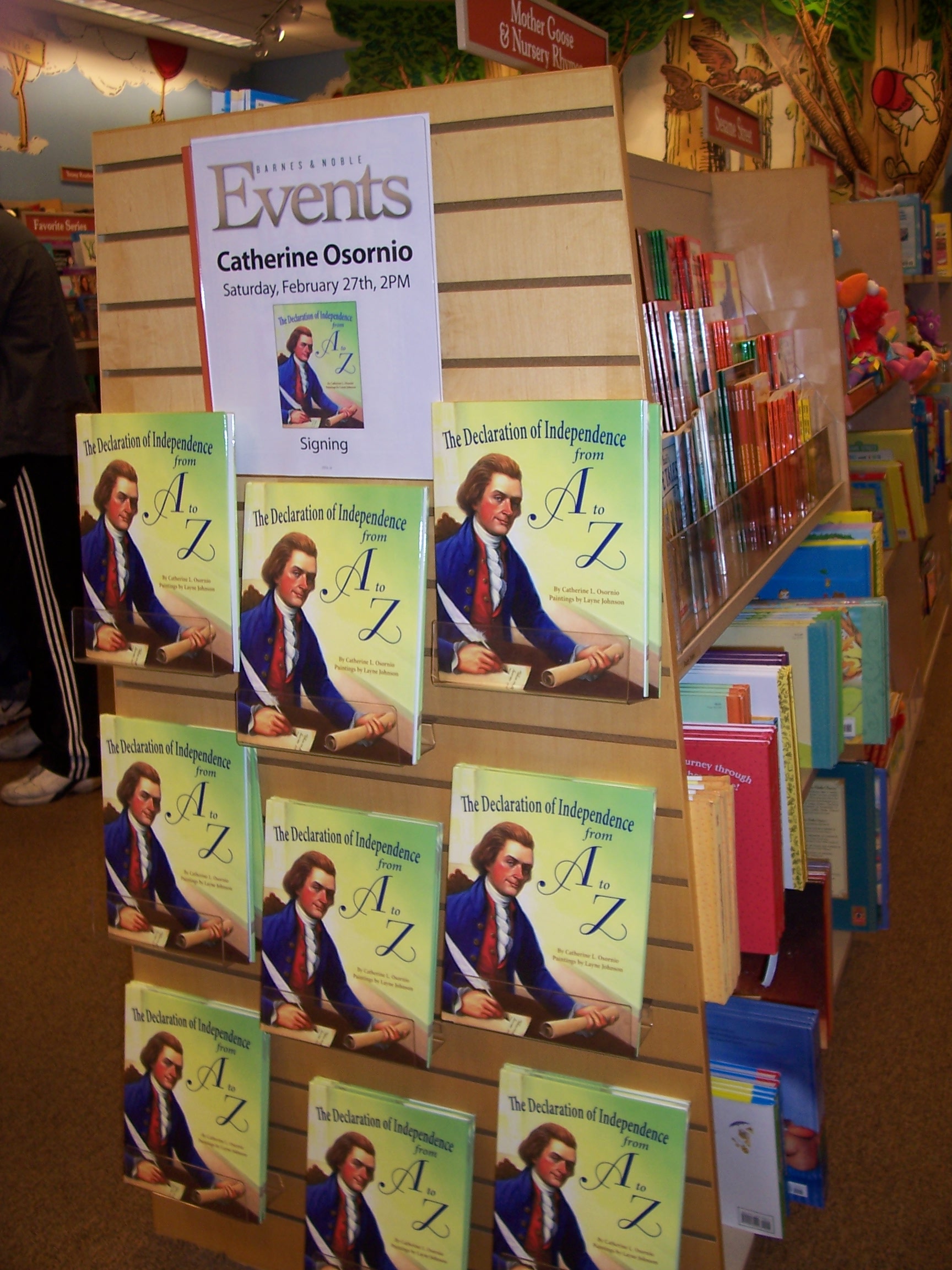
This past Saturday I had the second book signing for my book, The Declaration of Independence from A to Z. This time, instead of at a small quaint book store, it was at a large two-story Barnes and Noble in Orange, CA.

The store was gorgeous. I had never been to this particular location before, and it was so different from other Barnes and Nobles. And, despite the on and off rainy day, the place was busy.

I was set up just inside the main entrance. There was a large poster with my name and the book cover outside the main entrance, and as you came in, I was seated to the right on a long table filled with my books.

If you happened to be distracted upon entering, you would have seen an endcap upstairs in the childrens’ section filled with my books and a smaller version of the outside sign. And, if you still missed these obvious displays, you would have heard announcements every so often that I was in the store available to sign copies of my book.

The signing was scheduled from 2pm to 4pm. I stayed a little longer since a friend got lost and was coming to buy 3 books for some co-workers. I loved when kids came up to look at my book, and then were a little shy and excited when I signed their copies. I also enjoyed the discussions I had with fellow Americans concerned with the current state of our country.

Thanks to Barnes and Noble in Orange for their hospitality, and for giving me the opportunity to have a signing at their store. Next week Magic Johnson is scheduled for a signing, so I’m thankful that a big store like this was willing to host a first time author like me.